Custom fastener kits organized for the way you build.
Webson Fasteners can package fasteners, electronic hardware and assembly components according to an assembly, job, work order or recurring production requirement. Custom kits help manufacturers reduce part handling, simplify material distribution and deliver the correct components to the point of use.
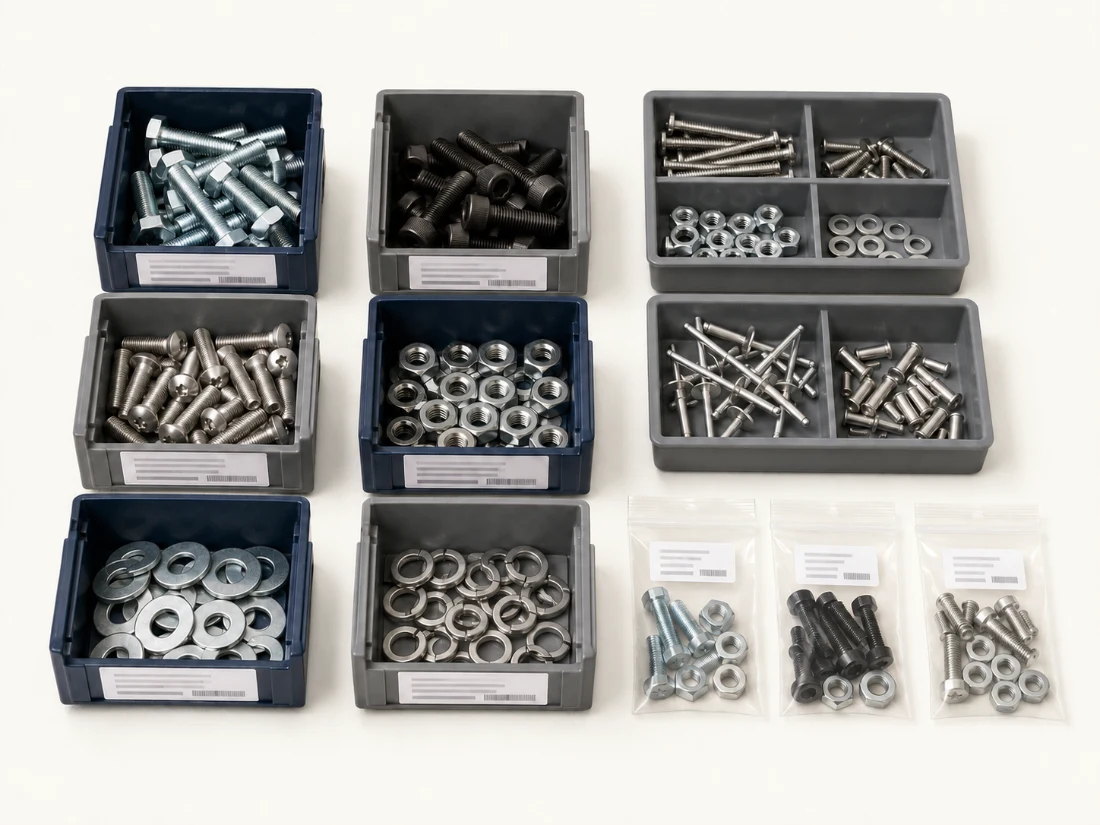
Handling that happens before assembly starts.
Hardware usually arrives the way it was purchased, not the way it will be used. Twenty line items land in twenty packages, and somebody has to turn that into what a single assembly needs. That work is real, it is repeated on every run, and it is normally absorbed by the people least able to spare the time.
Kitting moves selected preparation upstream. Components are grouped and packaged according to defined requirements before they ship, so what arrives matches the unit of work it supports. These are the conditions it is generally aimed at:
Components arriving separately
Each line item comes in its own package, and the assortment has to be reconciled against the assembly before anything can be built.
Repetitive counting and sorting
Parts are counted out of bulk containers again for every build, with the same effort repeated each run.
Time spent gathering parts
Staff walk the stockroom collecting items for each assembly instead of working on the assembly itself.
Missing parts found during production
A shortage discovered mid-build stops work at the point where the interruption costs the most.
Excess line-side inventory
Bulk quantities held at the workstation to avoid shortages consume floor space and obscure actual usage.
Multiple orders for related parts
Components used together are ordered, received and reconciled separately even though they are consumed as a set.
Distributing hardware across jobs
Splitting bulk hardware across concurrent jobs or work orders is manual and easy to get wrong.
Packaging that varies by run
Presentation that changes between production runs makes the same task slower to perform and harder to check.
Kitting organizes components according to agreed requirements and shifts selected preparation work away from the production team. It does not eliminate shortages, errors or production delays, and every kit remains dependent on the accuracy of the bill of material it is built from.
Five steps from bill of material to delivered kit.
Kitting requirements are reviewed before anything is quoted. What Webson can prepare depends on the products involved, the quantities, the packaging instructions and the documentation the order requires.
-
01
Review the bill of material
Webson reviews the part numbers, descriptions, drawings, specifications, quantities and documentation requirements that make up the kit.
-
02
Define the kit structure
The customer identifies how components should be grouped — by assembly, installation, job, work order or production quantity — and which items belong in each kit.
-
03
Confirm packaging requirements
Webson and the customer review package quantities, labeling instructions, documentation and any special handling requirements before the kit is quoted.
-
04
Source and prepare components
Approved parts are sourced or released from inventory and prepared according to the agreed kit structure.
-
05
Inspect and deliver
Kits are checked against the approved requirements and delivered according to the applicable order or program schedule.
Ways a kit can be structured.
The configurations below can be evaluated individually or in combination. Which applies depends on how the customer builds, how material is distributed internally and what the production schedule requires.
Assembly Kits
Every component required for one assembly or sub-assembly grouped as a single unit.
Job or Project Kits
Hardware grouped by job, project or contract so material stays associated with the work it belongs to.
Work-Order Kits
Components packaged against a specific work order and released to match the production schedule.
Installation Hardware Kits
The fastening hardware needed to install a unit, packaged separately from the unit itself.
Maintenance and Repair Kits
Replacement hardware grouped for a defined service, repair or preventive-maintenance task.
Controlled-Quantity Packages
Components supplied in a fixed count per package so consumption is easier to track and issue.
Multi-Component Fastener Kits
Related items such as a screw, washer and nut supplied together rather than as separate line items.
Scheduled or Recurring Releases
Repeating kits prepared to a standing structure and released on agreed dates.
Customer-specific packaging and labeling instructions can be reviewed as part of the quotation. Not every requested format can be accommodated — send the instructions with the requirement so Webson can confirm what is workable before the order is placed.
One kit across several product categories.
Because Webson supplies standard, electronic, specification-controlled and made-to-print hardware, a single kit can be evaluated containing items that would otherwise be bought from separate suppliers. A complete bill of material or purchase list can be submitted for review — there is no need to send each item as a separate request.
Commercial Hardware
Bolts, screws, studs, nuts and washers, plus pins, retaining rings and inserts in inch and metric sizes.
Electronic Hardware
Spacers, standoffs, handles, knobs and captive panel hardware for PCB, chassis and panel assembly.
Electronic Assembly Components
Rivets, grommets, clamps, cable ties and related joining, routing and sealing components.
Mil-Spec Hardware
AN, MS, NAS and NASM hardware, supplied to specification with the documentation the order requires.
Custom Fasteners and Finishes
Custom-manufactured fasteners and specially finished or patched components sourced to the customer’s drawing.
The components above are representative rather than a complete catalog. Send the bill of material and Webson will review what can be sourced and kitted together.
Where kitting tends to be worth the setup.
Kitting generally pays off where the same assembly is built repeatedly, where a build involves many small components, or where hardware has to travel to the work rather than the work coming to the stockroom.
Aerospace and Defense
Specification-controlled and commercial hardware grouped by assembly, with documentation requirements identified per part.
Electronics and Assembly
Board, panel and chassis hardware kitted per configuration across multiple product variants.
Medical Equipment
Repeating device and enclosure hardware prepared per assembly or service requirement.
Enclosures and Fabrication
Access, fastening and sealing hardware kitted per cabinet, rack or fabricated unit.
Lighting Equipment
Fixture, bracket and driver hardware packaged by fixture SKU or work order.
Security Equipment
Panel and enclosure hardware, including tamper-resistant items, grouped per unit.
General Industrial Manufacturing
Production hardware kitted for recurring builds and standard product lines.
Field Installation and Maintenance
Installation and repair hardware packaged so a technician carries one kit instead of loose stock.
See the full range of sectors Webson supports on the industries page.
Control of the parts and of the package.
A kit introduces a second thing to get right. The individual components have to be correct, and so does the completed package. Kits are prepared under the same AS9120B and ISO 9001 certified quality-management system Webson applies to any other order.
Part-Number and Description Review
Items on the bill of material are reviewed and confirmed against the identification supplied by the customer.
Verification Against Kit Requirements
Completed kits are checked against the approved structure and content before release.
Quantity Checks
Counts per component and per kit are verified according to the agreed requirements.
Separation of Similar Components
Items that are visually close — adjacent lengths, similar drive styles — are handled so they stay distinguishable in the kit.
Material and Lot Traceability
Traceability is applied when required by the purchase order or applicable specification. It is not automatic for every commercial component.
Certification and Documentation
Certificates and supporting documents can be supplied according to the component and customer requirements, identified per part number.
Packaging and Labeling Review
Package format and labeling instructions are reviewed against what was agreed before kits ship.
Change Control
When the bill of material is revised, the revision should be submitted so the kit structure is updated rather than assumed.
Kitting alongside inventory planning.
Kitting answers how components arrive. Inventory planning answers when. Used together on a recurring assembly, they can form a repeatable supply process: the kit structure stays fixed, and replenishment follows the production schedule rather than individual purchase orders.
Vendor-Managed Inventory
Kit components can be held under a managed program so recurring kits draw from agreed stock.
Scheduled Releases
Standing kits released on agreed dates against the customer’s production schedule.
Blanket-Order Programs
A total kit quantity placed under one order and drawn down over the program period.
Local Inventory Support
Agreed components or completed kits held for release from Webson’s Deer Park, New York facility.
Just-in-Time Delivery
Kits timed to production requirements instead of held as line-side stock, where usage supports it.
Bin Stocking
Kitted or loose hardware replenished at designated stocking or point-of-use locations.
These arrangements can be evaluated depending on the products, volumes and program requirements. Read more about vendor-managed inventory and bin stocking.
Information that makes a kitting quote accurate.
Partial information is still worth sending. The list below is what makes a quotation precise rather than a set of prerequisites before Webson can start reviewing.
Bill of Material or Part List
The complete component list for the kit, in whatever format it already exists.
Part Numbers and Descriptions
Manufacturer or customer part numbers, with descriptions for items not identified by number.
Drawings or Specifications
Applicable drawings and specifications for controlled or made-to-print components.
Quantity Per Kit
How many of each component belong in a single kit.
Number of Kits Required
Total kit quantity, and whether it is a one-time build or a recurring requirement.
Required Delivery Schedule
When kits are needed, and whether delivery follows a schedule or is released on demand.
Packaging Configuration
How components should be packaged and presented, including any bag, box or bin requirements.
Labeling Instructions
What should appear on the package and how kits need to be identified on receipt.
Material, Finish and Grade
Material, grade or property class and finish requirements per component.
Certification or Traceability
Documentation required by the order or specification, identified per part number.
Revision Levels
Current revision for each drawing or specification referenced in the kit.
Examples or Photographs
Images of an existing kit or current packaging, where available, to clarify the intended result.
Purchase lists, drawings, bills of material and other supporting files can be attached directly to the request on Webson’s RFQ page.
Submit Your Kit Requirements →Kitting and packaging questions.
What is a custom fastener kit?
A custom fastener kit is a group of components packaged together according to a defined requirement rather than supplied as separate line items. The grouping is set by the customer — by assembly, installation, job, work order or production quantity — so the parts needed for that unit of work arrive together.
Can Webson kit components from multiple product categories?
Yes. A kit can be evaluated containing commercial fasteners, electronic hardware, assembly components, Mil-Spec hardware and custom-manufactured parts. Combining categories in one kit is often the reason a program is worthwhile, since it removes the need to gather related items from separate orders.
Can kits be organized by assembly or work order?
Yes. Kits can be structured by assembly, sub-assembly, installation, job, work order or a set production quantity. The customer defines the grouping and Webson reviews whether it can be prepared as specified.
Can Mil-Spec and traceable hardware be included in a kit?
Mil-Spec and specification-controlled hardware can be included. Certification, traceability and documentation requirements should be identified per part number so they are applied when required by the purchase order or applicable specification.
Can Webson source the components as well as package them?
Yes. Webson can quote stocked items, source non-stock requirements and coordinate custom-manufactured components, then prepare the approved parts as kits. A complete bill of material can be submitted rather than each item individually.
Can recurring kits be supplied on a release schedule?
Recurring kits can be evaluated for scheduled releases and combined with vendor-managed inventory, blanket-order or bin-stocking arrangements, depending on the products, quantities and program requirements.
What information is needed for a kitting quote?
Send the bill of material or part list with quantities per kit, the number of kits required, drawings and revision levels, packaging configuration, labeling instructions, material and finish requirements, documentation requirements and the delivery schedule.
Is there a minimum order quantity for custom kits?
There is no published minimum. Feasibility depends on the number of components in the kit, the kit quantity, packaging requirements, production frequency and the overall scope of the program. Send the requirement and Webson will review it.
More from Webson Fasteners.
Vendor-Managed Inventory
Managed replenishment, bin stocking, scheduled releases and blanket-order programs.
Products
The complete range of commercial, electronic, assembly, Mil-Spec and custom hardware.
Commercial Hardware
Bolts, screws, studs, nuts, washers and related standard fasteners.
Electronic Assembly Components
Rivets, grommets, clamps, gaskets, O-rings and cable ties for assembly.
Mil-Spec Hardware
AN, MS, NAS and NASM hardware supplied to specification with aerospace-grade traceability.
Industries
The sectors Webson supplies, from aerospace and electronics to medical and life-safety equipment.
Certifications
AS9120B and ISO 9001 certification for the distribution of fastening products and installation tooling.
Have a bill of material that could be supplied as a kit?
Send Webson the component list, quantities, packaging instructions and delivery requirements. We will review the program and determine the most practical sourcing and kitting approach.