Vendor-managed fastener inventory built around your production.
Webson Fasteners develops inventory programs for manufacturers with recurring fastener and component requirements. Vendor-managed inventory, scheduled releases and bin-stocking programs help keep frequently used parts available while reducing purchasing activity, shortages and excess stock.
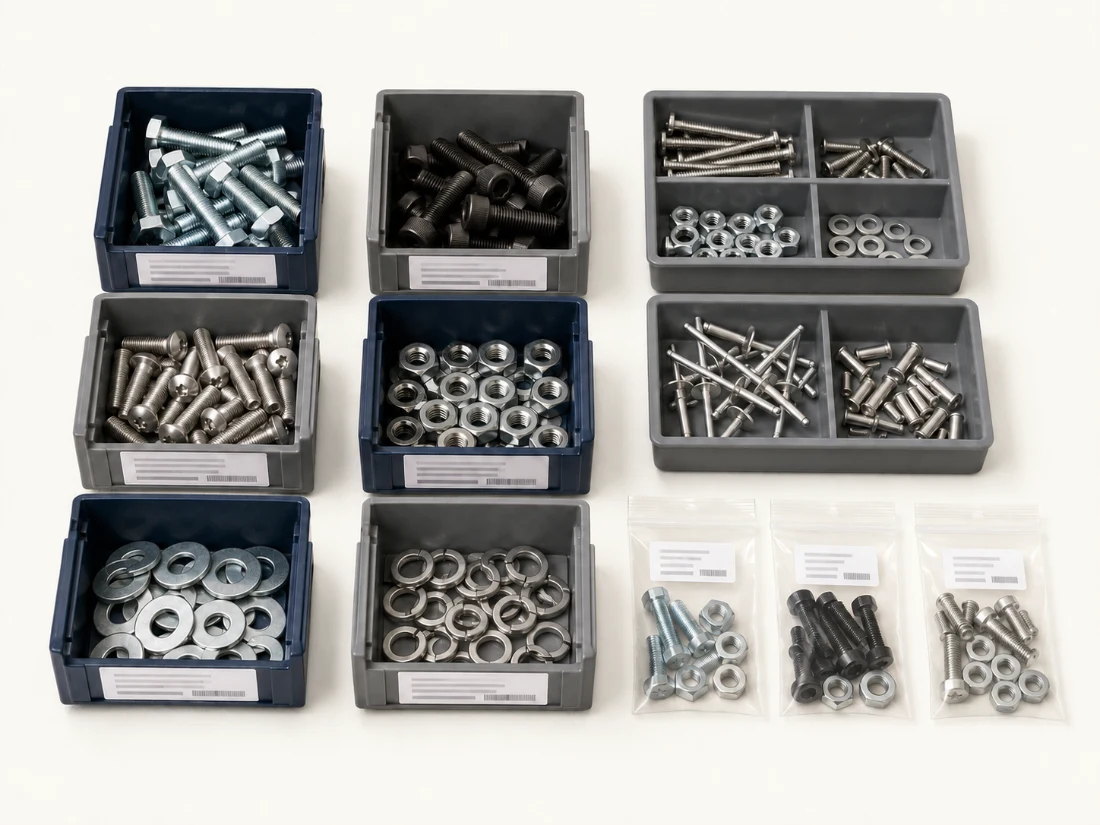
Inventory support for the parts you buy again and again.
Most production operations buy the same fasteners repeatedly. The part numbers rarely change, the usage is reasonably predictable, and the individual cost is low. What is expensive is the administration around them, and the disruption when one of them runs out. A Webson inventory program can cover frequently purchased commercial fasteners, electronic hardware, assembly components, Mil-Spec hardware and custom parts under a single arrangement.
These are the conditions a program is generally designed to address:
Production interrupted by low-cost parts
A finished assembly held up for a washer, rivet or cable tie costs far more than the component. Managed replenishment is aimed at the items most likely to be overlooked.
Repetitive purchase orders
Recurring items generate a steady stream of requisitions, orders, expedites and invoices for parts whose requirements are already well understood.
Excess safety stock
Uncertainty about lead time and availability tends to be answered with extra inventory, which consumes cash and floor space.
Inconsistent delivery timing
When each order is placed independently, arrival dates drift out of step with the production schedule.
Time spent watching common fasteners
Monitoring bins and shelves for routine hardware occupies buyers, planners and production staff who have higher-value work.
Several suppliers for related categories
Commercial, electronic, assembly, Mil-Spec and custom items are often split across vendors even when one distributor can quote all of them.
Coordinating usage against lead time
Matching consumption rates to replenishment intervals and supplier lead times is difficult to maintain part by part.
Demand that moves
Volume changes, engineering revisions and new bills of material shift requirements faster than static reorder points can follow.
A program is intended to make recurring requirements easier to manage and more predictable. It does not eliminate every shortage, and Webson does not guarantee a specific cost reduction — results depend on the parts, usage accuracy, lead times and how the program is maintained.
Four steps from purchase list to managed program.
Webson does not apply a fixed template. Every program is built from the customer’s own purchasing and production requirements, and the scope is agreed before anything is stocked.
-
01
Review requirements
Webson reviews the part numbers, specifications, usage history, order frequency, lead times and any required documentation. This step establishes what is actually being consumed and how predictable it is.
-
02
Design the program
Webson and the customer determine which parts are suitable for the program, along with stocking quantities, release schedules and replenishment expectations. Items that are too variable or too infrequent may be better handled as ordinary orders.
-
03
Stock and supply
Approved products are purchased, stocked or scheduled according to the agreed program, with releases and deliveries following the terms set during design.
-
04
Review and adjust
Usage and requirements can be reviewed as production volumes, bills of material or delivery needs change, and stocking levels adjusted accordingly.
Arrangements that can be combined or used on their own.
The options below can be evaluated individually or together. Which ones apply depends on the products, volumes, facility arrangements and program requirements — not every option is appropriate for every customer or every part number.
Vendor-Managed Inventory
Webson monitors and replenishes agreed items against the program, so recurring parts are handled without a separate purchase order each time.
Bin Stocking
Frequently used hardware is organized and replenished at designated stocking or point-of-use locations, at levels and a review cadence set with the customer.
Just-in-Time Delivery
Deliveries are timed to production requirements rather than held as on-hand stock, where usage is predictable enough to support it.
Scheduled Releases
Quantities are committed once and released against the customer’s production schedule on agreed dates.
Blanket-Order Programs
A total quantity is placed under one order and drawn down over the program period, reducing repeated order placement.
Local Inventory Support
Webson can hold agreed items for release from its Deer Park, New York facility where the program calls for it.
Custom Kitting and Packaging
Components are grouped, identified and packaged by assembly, production stage or bill of material so they arrive ready to use.
One program across several product categories.
Because Webson supplies standard, electronic, specification-controlled and made-to-print hardware, a single program can potentially combine categories that would otherwise be split across separate suppliers. That consolidation is often the practical benefit: one relationship, one set of terms and one point of contact for related components.
Commercial Hardware
Bolts, screws, nuts and washers, plus pins, retaining rings, threaded rod and inserts in inch and metric sizes.
Electronic Hardware
Spacers, standoffs, handles, knobs, bushings and captive panel hardware for PCB, chassis and panel assembly.
Electronic Assembly Components
Rivets, grommets, clamps, gaskets, O-rings, cable ties and related joining, routing and sealing components.
Mil-Spec Hardware
AN, MS, NAS and NASM hardware, supplied to specification with the documentation the order requires.
Custom Fasteners and Finishes
Custom-manufactured and specially finished components sourced to the customer’s drawing and revision.
The items above are representative rather than a complete catalog. Send the part numbers you buy most often and Webson will review which of them fit a program.
Where a managed program tends to fit.
Inventory programs are generally most useful where the same hardware is consumed on a repeating schedule and a stockout stops work. That describes a wide range of the manufacturers Webson supplies.
Aerospace and Defense
Recurring specification-controlled and commercial hardware supporting airframe, avionics and ground-equipment production.
Electronics and Assembly
Board-level, panel and chassis hardware consumed across multiple product configurations.
Medical Equipment
Repeating hardware requirements for device housings, enclosures and supporting assemblies.
Enclosures and Fabrication
Access, fastening and sealing hardware for sheet-metal, cabinet and rack production.
Lighting Manufacturing
Fixture, bracket and driver-enclosure hardware running across multiple fixture SKUs.
Security and Safety Equipment
Tamper-resistant and corrosion-resistant hardware for panels, enclosures and mounted units.
General Industrial and Maintenance
Production and MRO hardware for manufacturers, fabricators and service organizations.
See the full range of sectors Webson supports on the industries page.
Convenience without losing control of the part.
A managed program changes how parts are replenished, not how they are controlled. Items supplied under a program move through the same AS9120B and ISO 9001 certified quality-management system Webson applies to any other order.
Purchase-Order and Specification Review
Program terms, part numbers and applicable specifications are reviewed so releases match what was agreed.
Material and Lot Traceability
Traceability is applied when required by the order or applicable specification. It is not automatic for every commercial item.
Certification and Documentation
Certificates and supporting documents can be supplied according to the component and customer requirements, which should be identified per part number.
Part-Number Control
Program items are managed by controlled part number so substitutions are not introduced without customer agreement.
Receiving Inspection
Incoming product is handled under Webson’s established receiving and quality procedures before it enters program stock.
Documentation Retention
Records are retained according to the applicable quality-system and customer requirements.
Information that makes a proposal accurate.
The more of the following Webson has up front, the more specific the program review can be. Partial information is still worth sending — the list below is what makes a proposal precise, not a barrier to starting.
Part Numbers and Descriptions
Manufacturer or customer part numbers, with descriptions for any item that is not identified by number.
Drawings or Specifications
Applicable drawings, revisions and specifications for controlled or made-to-print items.
Current or Estimated Annual Usage
Annual consumption per part number, actual where available and estimated where not.
Typical Order Quantities
The quantities normally purchased at one time, and any packaging increments already in use.
Required Delivery Frequency
How often material is needed, and whether releases follow a schedule or on-demand pattern.
Current Lead Times
Lead times currently experienced on these items, including any that cause recurring problems.
Material and Finish Requirements
Material, grade or property class, and finish or plating requirements per part number.
Certification or Traceability Requirements
Documentation required by the order or specification, identified per part number.
Packaging, Labeling or Kitting
Bag, box, bin, label or kit requirements, including how parts are presented at point of use.
Known Changes or Demand Variability
Planned volume changes, engineering revisions, new programs or seasonal swings that affect usage.
A purchasing list, bill of material, drawing or other supporting file can be attached directly to the request on Webson’s RFQ page.
Submit Your Requirements →Inventory program questions.
What is vendor-managed inventory for fasteners?
Vendor-managed inventory is an arrangement in which Webson takes responsibility for monitoring and replenishing agreed fastener and component items against a program developed with the customer. Rather than issuing a purchase order each time a part runs low, the customer identifies the parts, usage and delivery expectations once, and Webson manages replenishment within those terms.
Which products can be included in a Webson inventory program?
Commercial fasteners, electronic hardware, assembly components, Mil-Spec hardware and custom-manufactured parts can all be evaluated for inclusion. Which specific items are suitable depends on the part numbers, usage, order frequency, lead times and documentation requirements.
Does Webson offer on-site bin stocking?
Bin stocking can be evaluated where appropriate. Frequently used hardware is organized and replenished at designated stocking or point-of-use locations according to the agreed program, levels and review cadence.
Can Webson support scheduled releases or blanket orders?
Yes. Scheduled-release and blanket-order arrangements can be evaluated so that quantities are committed once and released against the customer’s production schedule, depending on the products, volumes and program requirements.
Can Mil-Spec and traceable hardware be included?
Mil-Spec and specification-controlled hardware can be included in a program. Certification, traceability and documentation requirements should be identified for each part number so they are applied when required by the order or applicable specification.
Is there a minimum purchase volume for an inventory program?
There is no single published threshold. Suitability depends on the number of parts, annual usage, order frequency, lead times and the overall requirements of the program. Send the part list and usage information and Webson will review whether a program is appropriate.
Can Webson review an existing fastener purchase list?
Yes. Customers can submit a purchasing list, bill of material or usage history for review. Webson can identify which items are stocked, which require sourcing and which are suitable candidates for a managed program.
How do we request an inventory-program proposal?
Send the part numbers, descriptions, usage information, delivery expectations and any documentation requirements through Webson’s RFQ page. Purchasing lists, bills of material and drawings can be attached to the request.
More from Webson Fasteners.
Products
The complete range of commercial, electronic, assembly, Mil-Spec and custom hardware.
Commercial Hardware
Bolts, screws, studs, nuts, washers and related standard fasteners.
Mil-Spec Hardware
AN, MS, NAS and NASM hardware supplied to specification with aerospace-grade traceability.
Custom Fasteners and Finishes
Made-to-print components with coordinated machining, forming, plating and finishing.
Industries
The sectors Webson supplies, from aerospace and electronics to medical and life-safety equipment.
Certifications
AS9120B and ISO 9001 certification for the distribution of fastening products and installation tooling.
Ready to simplify recurring fastener purchases?
Send Webson your frequently purchased part numbers, usage information or current purchase list. We will review the requirements and determine whether a vendor-managed inventory, bin-stocking or scheduled-release program is appropriate.